Domain Authority vs Page Authority what’s the real difference? Learn how both Moz scores work, what a good DA and PA score means, and website authority how to improve your rankings in 2026.
Why DA and PA Matter in 2026
If you have ever wondered why some websites consistently appear on page one of Google while others with great content are buried on page five the answer often comes down to two key SEO metrics: Domain Authority (DA) and Page Authority (PA).
These two scores, developed by Moz, help SEO professionals and website owners understand how strong a website or a specific page is in the eyes of search engines. But they measure very different things, and confusing one for the other can lead to poor SEO decisions and wasted effort.
In 2026, with Google’s AI-driven ranking systems like RankBrain and the Helpful Content Update now fully in play, understanding these metrics is more important than ever.
This complete guide will walk you through exactly what Domain Authority and Page Authority are, how they are calculated, what scores are considered good, how to check them for free, and most importantly how to improve both so your website ranks higher, gets more clicks, and drives real traffic.
Key Takeaway
Domain Authority measures the strength of your ENTIRE website. Page Authority measures the strength of ONE specific page. Both are scored from 1 to 100. Neither is a direct Google ranking factor — but both are powerful predictive tools for your SEO strategy.
1: What is Domain Authority (DA)?
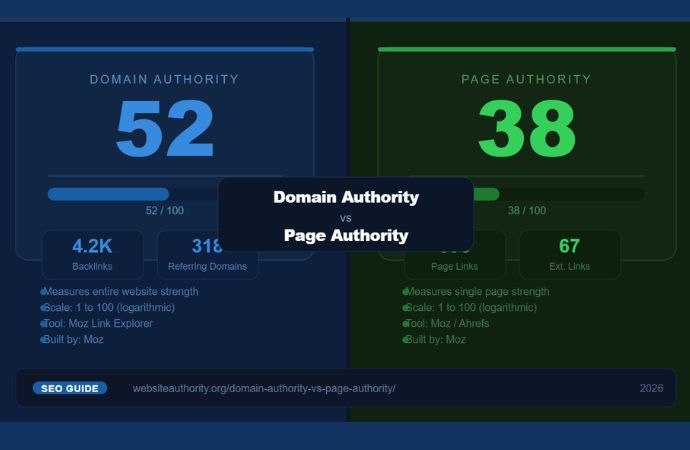
Domain Authority is a search engine ranking score created by Moz. It predicts how likely your entire website is to rank on search engine results pages (SERPs). The score runs from 1 to 100 — the higher the number, the stronger your website is considered to be in competition.
Domain Authority as the overall reputation of your entire house how trusted your full domain is across the internet, based on the total backlink profile of all your pages combined.
How is Domain Authority Calculated?
Moz calculates Domain Authority by running a machine learning model that processes billions of web pages via its own web index. The algorithm primarily looks at three core factors:
• Inbound Link Metrics: The number of backlinks pointing to your domain, their quality, and how much link equity they pass
• Referring Domains: How many unique websites link to your domain — one link from 100 different websites is far more valuable than 100 links from the same single website
• Spam Signal Detection: Moz’s system filters out low-quality, spammy, or manipulative links so they do not inflate your score artificially
Importantly, Domain Authority is measured on a logarithmic scale. This means it becomes progressively harder to improve your score as it gets higher. Moving from DA 20 to DA 30 requires far less effort than moving from DA 70 to DA 80.
What is a Good Domain Authority Score in 2026?
Domain Authority scores vary significantly by industry. Here is a general benchmark to help you interpret your score:
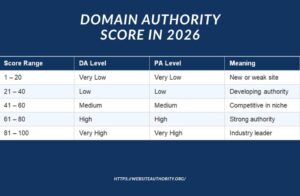
According to SEO research, Forbes carries a Domain Authority of around DA 95, while a well-established niche blog might sit at DA 35 to 50. For a new website in 2026, targeting DA 20 to 35 within your first 12 months is a realistic and meaningful goal.
What is Page Authority (PA)?
Page Authority works on exactly the same 1 to 100 scale as Domain Authority, but it measures something fundamentally different. While DA looks at your entire website, Page Authority focuses on the ranking strength of a single specific page or URL.
Using the same house analogy if Domain Authority is the reputation of the entire building, then Page Authority is the strength of one particular room inside that building. A room can be renovated and strengthened independently, even if the overall house has modest prestige.
How is Page Authority Calculated?
Moz calculates Page Authority using a similar machine learning model to DA, but scoped to individual URLs rather than the full domain. The key inputs are:
• Backlinks to that specific page: The quantity and quality of external links pointing directly to that URL
• Internal links from within your own website: Pages that receive strong internal linking from high-authority pages on your site gain more PA
• On-page optimization signals: Proper keyword placement, use of LSI (Latent Semantic Indexing) terms, and semantic content structure all contribute
• User engagement signals: Lower bounce rates and longer dwell time on that page correlate with higher PA over time
Why Page Authority Matters More for Individual Rankings
Something crucial that many website owners overlook: a page with a high PA can outrank pages from websites with a much higher DA if that page is more relevant to the user’s search query.
Core insight: Domain Authority gives your site a foundation to compete broadly, but Page Authority determines whether that specific page wins for a specific keyword. A low-DA site with one exceptionally well-built, well-linked page can absolutely appear above high-DA competitors for the right query.
Domain Authority vs Page Authority
Now that we understand both metrics individually, let us put them side by side in a direct comparison. This table covers everything you need to know:
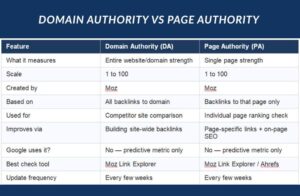
The Most Important Distinction
Domain Authority = How competitive your overall website is. Improves slowly over time as your entire backlink profile grows.
Page Authority = How strong ONE specific page is. Can improve faster than DA through focused link building and internal linking strategies.
How to Check Domain Authority and Page Authority for Free
You do not need to spend money to check your DA and PA scores. Here are the best free tools available in 2026:
1. Moz Link Explorer (Free Version)
Moz’s own Link Explorer is the most accurate tool for checking both DA and PA since Moz created these metrics. The free version allows you to check up to 10 queries per month. Simply enter your domain or URL, and you will see your DA, PA, total backlinks, and linking root domains.
2. Moz SEO Browser Extension
Moz browser extension (available for Chrome and Firefox) displays DA and PA scores directly in your search results as you browse. This is extremely useful for competitive research — you can instantly see the authority of every result on a Google SERP page.
3. Ubersuggest (Neil Patel’s Free Tool)
Ubersuggest provides a Domain Score (similar to DA) alongside keyword rankings, competitor analysis, and backlink data — all in a clean, easy-to-understand interface. Ideal for beginners and small business owners.
4. Ahrefs Free Webmaster Tools
Ahrefs offers its Domain Rating (DR) metric — which is different from Moz DA but measures a similar concept for free if you verify ownership of your website. This gives you one of the most reliable authority metrics available.
5. Semrush Authority Score (Free Checks)
Semrush’s Authority Score is considered one of the most manipulation-resistant metrics in 2026 because it factors in both backlink quality AND actual organic traffic. A site can have hundreds of purchased links and see a Moz DA bump, but Semrush Authority Score stays flat if those links drive no real traffic.
5: How to Improve Domain Authority 6 Proven Strategies
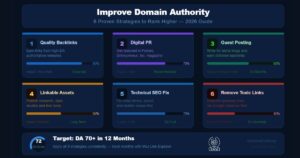
Improving your Domain Authority requires consistent effort over time because it reflects the health of your entire website’s backlink profile. Here are the six most effective strategies for 2026:
1: Build High-Quality Backlinks from Authoritative Websites
Backlinks remain the single strongest way to increase Domain Authority. Focus on earning links from websites that are relevant to your niche and carry their own strong authority. One link from a DA 70 industry blog is worth more than fifty links from DA 5 directories.
2: Digital PR and Journalist Outreach
Digital PR is the most reliable route to high-authority editorial backlinks. Use platforms like Featured.com (which relaunched in April 2026 with the original HARO free email format) to respond to journalist queries and earn mentions in publications like Forbes, Entrepreneur, and Inc. sites with DA scores above 70.
3: Guest Posting on Relevant Blogs
Write high-value articles for other blogs in your niche that include a natural backlink to your site. Focus on topical relevance over pure DA — a DA 40 blog in your exact niche is more valuable than a DA 60 blog that has nothing to do with your industry.
4: Create Linkable Assets
Publish original research, comprehensive data studies, free tools, or infographics that other websites naturally want to link to. Content that fills a gap or answers a question no other source covers well will earn links passively over time.
5: Fix Your Technical SEO Foundation
A website with slow load speeds, broken links, crawl errors, or poor mobile responsiveness will struggle to build authority. Google needs to efficiently crawl and index your site for your link equity to flow properly. Run a technical SEO audit every quarter.
6: Eliminate Toxic and Spammy Backlinks
Backlink profile contains low-quality, irrelevant, or spammy links — from link farms, paid link networks, or unrelated directories use Google’s Disavow Tool to remove their negative influence. Cleaning your profile is just as important as building new quality links.
6: How to Improve Page Authority — 5 Fast Strategies
Page Authority can be improved faster than Domain Authority because you are targeting a single URL rather than the entire domain. Here is how to boost PA for your most important pages:
1: Build Direct Backlinks to That Specific Page
The most direct way to raise a page’s PA is to earn external backlinks that point to that exact URL — not just your homepage. When you write guest posts or create content partnerships, request that the link points to the specific article or service page you want to boost.
2: Use Internal Linking Strategically
Internal linking is one of the most underutilized tactics for increasing Page Authority. According to 2026 research, a solid internal linking strategy can boost search rankings by up to 40% and improve organic traffic by 30% or more.
Practical rules: aim for 2 to 5 contextual internal links per 1,000 words on any given page. Use descriptive anchor text that varies naturally — exact-match anchor text should make up only 15 to 25% of links to any given page. Keep your most important pages within 3 clicks of the homepage.
3: Optimize On-Page SEO Completely
A page to rank well, both its PA and its on-page optimization need to be strong. Ensure your target keyword appears in: the title tag (H1), the first 100 words of the article, at least two H2 subheadings, the meta description, the URL slug, and in image alt text.
4: Refresh and Update Existing Content
Pages that are regularly updated signal freshness to Google and often see PA improvements. Review your most important articles every 6 months. Add new data, update outdated statistics, improve clarity, and add new internal links to newer content you have published.
5: Improve Page Speed and User Experience
User engagement signals how long people stay on your page, whether they scroll, whether they click to other pages influence PA over time. A page that loads in under 2 seconds, displays well on mobile, and provides a clear, readable layout will retain visitors longer and signal quality to search engines.
7: DA vs PA — Which Should You Focus On?
This is the question most website owners struggle with. The honest answer is: it depends on where your website is right now.
Focus on Page Authority if:
• Your website is new or has a DA below 20
• You have a specific article or landing page you urgently want to rank for a particular keyword
• You are competing in a low-to-medium competition niche
• You want faster, more measurable results from your SEO efforts
Focus on Domain Authority if:
• Your website is more than 1 year old and you are ready to compete more broadly
• You want to rank for multiple keywords across many pages simultaneously
• You are in a highly competitive niche where DA 40+ is needed to reach page one
• You are building a long-term content brand or authority site
The Smart Strategy
The strongest SEO approach in 2026 balances both: build domain-wide trust over time through consistent link building and content publishing, while simultaneously targeting your highest-priority pages with focused page-level optimization. Neither metric alone tells the full story — use both together as compass points for your strategy.
8: DA and PA in the Age of AI Search (2026 Update)
Authority signals carry increased weight not only in traditional Google rankings but also in AI-driven search systems. Citation tools like Perplexity AI, ChatGPT Search, and Google’s AI Overviews tend to surface content from domains with established credibility and topical depth.
The link-building and content work you do today to grow your Domain Authority is the same work that positions your brand to appear in AI-generated answers. Sites with DA scores between 30 and 45 regularly outrank higher-DA competitors when they demonstrate stronger topical depth on a specific subject and AI search engines reward this topical focus even more than traditional Google does.
The message for 2026 is clear: build topical authority in your niche, earn quality backlinks consistently, optimize every important page individually, and your DA and PA will grow together carrying your rankings across both traditional search and AI search platforms.
FAQs:
Does Google use Domain Authority or Page Authority as a ranking factor?
No. Google does not use Moz’s DA or PA scores in its ranking algorithm. These are third-party predictive metrics developed by Moz to help SEO professionals benchmark performance. Google uses its own internal PageRank system, which is not publicly visible.
Can a low-DA website outrank a high-DA website?
Yes absolutely. A website with DA 25 can outrank a DA 70 website if its specific page has stronger Page Authority, better on-page optimization, more relevant content, and stronger alignment with user search intent for that particular query.
How long does it take to increase Domain Authority?
Domain Authority improves gradually over months and years. For a new website, gaining 10 to 20 DA points in the first year through consistent content publishing and link building is a realistic target. Faster growth requires more aggressive link building, digital PR, and viral content.
How often do DA and PA scores update?
Moz updates DA and PA scores every few weeks as its web crawler processes new backlink data from across the internet. Fluctuations of 1 to 3 points between updates are normal and should not cause concern.
What is the difference between Moz DA and Ahrefs DR?
Moz Domain Authority (DA) and Ahrefs Domain Rating (DR) both measure a website’s backlink-based authority on a 1 to 100 scale but they use different proprietary algorithms and different web indices. Neither is better than the other; experienced SEOs use both together for a more complete picture.
Can I have a high DA but low PA on some pages?
Yes, this is very common. Your homepage might have a PA of 55 while a new blog post only has a PA of 12. Building internal links from high-PA pages to newer pages, and earning external links to those specific URLs, will gradually bring their PA up.
Conclusion:
Domain Authority and Page Authority are not competing metrics — they are complementary tools that together give you a clear picture of your website’s SEO health.
DA tells you how strong your brand is across the entire web. PA tells you whether individual pages are equipped to win their target keywords.
The websites that dominate search results in 2026 do not focus on one at the expense of the other. They build their domain authority systematically through consistent backlink acquisition, digital PR, and content publishing while simultaneously optimizing each important page through focused on-page SEO, smart internal linking, and page-specific link building.
If you are just getting started, begin with Page Authority: pick your five most important articles, build internal links to them, earn a few quality external links to those specific URLs, and optimize their on-page content. Your DA will grow naturally as your content earns more links site-wide.
Use free tools like Moz Link Explorer, Ubersuggest, and Semrush to track your progress monthly. Set realistic benchmarks for your niche. And remember — consistency always beats intensity in SEO.
Start Today
1. Check your current DA and PA at Moz Link Explorer (free).
2. Identify your 3 most important pages that need a PA boost.
3. Add 3 to 5 internal links to each of those pages from your other articles.
4. Reach out to one relevant website this week for a backlink. Do this consistently for 6 months and watch your rankings grow.