Why Your SEO Strategy Determines Your Online Success
Having a website in 2026 is just the beginning. If your business doesn’t appear prominently on Google, Bing, ChatGPT Search, or Perplexity, your digital presence is essentially invisible. Building a strong, well-executed SEO strategy is no longer optional, it is the foundation of sustainable digital growth, whether you run a local business, a SaaS startup, or an eCommerce brand.
The data tells a compelling story. Organic search generates over 1,000% more traffic than organic social media (BrightEdge). A well-run SEO campaign delivers a median ROI of approximately 748%, meaning every dollar you invest returns around $7.48 in value.
For B2B SaaS businesses, that figure climbs to 702% (FirstPageSage). With 68% of all online experiences beginning at a search engine, there has never been a stronger case for building your SEO strategy now.
But here’s what most guides miss: the SEO landscape has fundamentally shifted. Strategies from 2022 or even early 2024 are no longer sufficient. Google’s algorithm has matured. AI-powered search tools, including Google AI Overviews, ChatGPT Search, and Perplexity, are actively reshaping how users discover, evaluate, and choose brands. In 2026, a winning SEO strategy must account for all of this.
This guide walks you through everything you need, from core SEO pillars to AI search optimization, keyword research, content strategy, and a practical framework you can start implementing today.
What Is an SEO Strategy? (And Why It Matters More Than Ever)
An SEO strategy is a structured, long-term plan for improving your website’s visibility across search engine results pages (SERPs). It includes keyword research, content development, technical optimization, link building, user experience improvements, and increasingly optimization for AI-generated search responses.
Unlike paid advertising, which delivers traffic only as long as you keep spending, SEO builds momentum over time. Each piece of quality content, each earned backlink, and each technical improvement compounds in value.
The goal of any modern SEO strategy is threefold:
- Attract targeted organic traffic from people actively searching for what you offer
- Build topical authority and brand trust that positions you as the go-to resource in your niche
- Convert visitors into customers, leads, or subscribers through strategically aligned content and user experience
Quick Summary: An SEO strategy is your long-term blueprint for ranking higher on search engines, earning organic traffic, and building brand authority without depending on paid advertising.
The 4 Core Pillars of a High-Performance SEO Strategy
SEO strategy as a four-legged structure. Each pillar must be strong remove one and the entire strategy becomes unstable.
Pillar 1: On-Page SEO
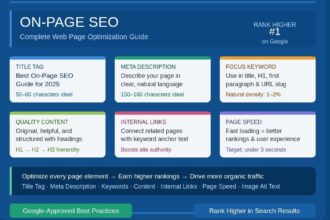
On-page SEO covers every optimization you make directly on your website — from content quality and keyword placement to title tags, meta descriptions, internal linking, and URL structure.
Key components include:
Keyword research and search intent: The most effective keyword strategies in 2026 prioritize search intent over raw monthly search volume. Understand why someone is searching before you decide what to write.
Title tags and meta descriptions: Title tags between 40–60 characters perform best for click-through rates. URLs that include the target keyword deliver up to 45% higher CTR compared to generic URLs.
Content quality and E-E-A-T: Google rewards content that genuinely demonstrates Experience, Expertise, Authoritativeness, and Trustworthiness. Thin, recycled, or AI-spun content without human oversight consistently underperforms.
Internal linking: Well-planned internal links distribute link equity across your site, help search crawlers discover new pages efficiently, and keep users engaged longer — all positive SEO signals.
Schema markup: Structured data helps search engines interpret your content accurately and qualifies pages for rich results like FAQ panels, review stars, how-to cards, and sitelinks.
Pillar 2: Technical SEO
Even the most well-written content won’t rank if search engines can’t properly crawl, index, and render your website. Technical SEO addresses the infrastructure that enables everything else.
Core Web Vitals: Google measures page experience through three metrics: Largest Contentful Paint (LCP) should be under 2.5 seconds, Interaction to Next Paint (INP) under 200 milliseconds, and Cumulative Layout Shift (CLS) below 0.1. As of 2026, only about 54.6% of websites pass all Core Web Vitals checks. Sites that meet these thresholds consistently see organic traffic increases of 12–20% and conversion rate improvements of 15–30%.
Mobile-first indexing: With 63% of global web traffic originating from mobile devices, Google now indexes the mobile version of your site first. A poor mobile experience directly suppresses rankings.
Page speed: A two-second delay in load time increases bounce rate by over 100%. Each additional second of delay costs approximately 7% in conversions.
HTTPS and site security: 84% of users leave sites flagged as insecure. HTTPS is non-negotiable for both rankings and user trust.
Crawlability: A clean XML sitemap, a properly configured robots.txt file, and logical site architecture ensure search engines can discover and prioritize your most important pages.
Pillar 3: Off-Page SEO and Link Building
Off-page SEO encompasses all the external signals that communicate your website’s authority and credibility to search engines. In 2026, quality has decisively overtaken quantity as the primary success metric.
High-authority backlinks: A single link from a respected, high-authority domain is worth more than dozens of links from low-quality sources. The average cost of acquiring a quality backlink in 2026 stands at $361, a reflection of how competitive this landscape has become.
Long-form content earns links: Content exceeding 2,000 words earns 77.2% more backlinks than shorter articles. Businesses that consistently publish blog content earn 97% more inbound links than those that don’t.
Digital PR and brand mentions: Identifying and converting unlinked brand mentions into backlinks is a high-efficiency off-page strategy. Guest contributions, expert roundups, original industry research, and shareable tools all generate natural links from authoritative sources.
Community presence: Reddit now appears in 37% of top Google search results. Active participation in relevant communities, earning legitimate reviews, and maintaining a strong brand presence across third-party platforms directly influences how AI systems perceive and recommend your brand.
Pillar 4: Content Strategy and Topical Authority
Content remains the engine that powers every effective SEO strategy but the rules have changed. Shallow articles, keyword-stuffed listicles, and generic AI-generated content are actively penalized. What wins today is depth, structure, genuine expertise, and alignment with the full spectrum of user intent.
Topic clusters: Instead of publishing isolated blog posts, build interconnected content hubs. A pillar page covers a broad topic comprehensively, while cluster content dives deep into related subtopics all internally linked. This signals topical authority to both Google and AI search systems.
Search intent alignment: Research consistently shows that approximately 70% of search queries carry informational intent, 22% are commercial, and only around 1% are transactional. Your content plan should serve all three stages of the buying journey.
Content freshness: Google and AI systems increasingly reward pages that demonstrate recency. Build regular content refresh cycles into your workflow updating statistics, expanding thin sections, and improving structure on pages with ranking potential.
Video SEO: Search results featuring video generate 157% more organic traffic than text-only pages. YouTube should be a central pillar of your content strategy, not an afterthought.
Quick Summary: A winning SEO strategy in 2026 requires four pillars working in sync — on-page optimization, technical excellence, quality link building, and a content approach built around topical depth and genuine user value.
SEO Pillar Comparison: On-Page SEO vs Off-Page SEO vs Technical SEO
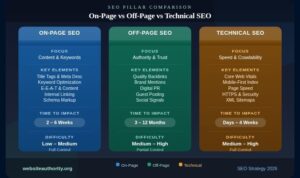
Search Engine Optimization (SEO) is divided into three major pillars: On-Page SEO, Off-Page SEO, and Technical SEO. Each plays a critical role in improving website visibility, organic traffic, and Google rankings.
On-Page SEO focuses on optimizing content, keywords, title tags, meta descriptions, internal links, and schema markup to make webpages more relevant for search engines and users.
Off-Page SEO is centered around building website authority through backlinks, brand mentions, online reviews, and digital reputation, which helps increase trust and domain strength over time. Meanwhile, Technical SEO ensures that a website is fast, secure, mobile-friendly, and easy for search engines to crawl and index by improving Core Web Vitals, HTTPS, XML sitemaps, and site architecture.
On-Page SEO usually delivers results within 2–6 weeks and Technical SEO can show improvements in days to 4 weeks, Off-Page SEO often requires 3–12 months for strong authority growth.
Together, these three SEO pillars create a complete optimization strategy that improves search engine rankings, enhances user experience, and supports long-term Google AdSense approval and sustainable organic growth.
The New Frontier: GEO, AEO and AI Search Optimization
Traditional SEO is the foundation, AI search optimization is the structure you’re building on top of it. In 2026, tools like ChatGPT Search, Google AI Overviews, and Perplexity are fundamentally reshaping how users find information and which brands they encounter first.
AI is projected to handle 25% of all global search queries by 2026. That’s a significant and accelerating shift in search behavior that serious SEO strategies can no longer ignore.
Three key optimization disciplines have emerged:
GEO (Generative Engine Optimization): Structuring your content so it gets cited and referenced in AI-generated search summaries. This requires clear, authoritative, well-organized content with strong entity signals and comprehensive schema markup.
AEO (Answer Engine Optimization): Formatting content to directly and concisely answer specific questions. AI systems prioritize content that delivers clear answers first, followed by supporting context and depth.
LLMO (Large Language Model Optimization): Ensuring your brand, products, and expertise appear in the outputs of large language models. This requires building visibility across authoritative third-party sources that LLMs reference during training and real-time retrieval.
The encouraging news is that the strategies that make you visible in AI search are largely the same as those that drive Google rankings authoritative content, strong E-E-A-T signals, structured data, and quality backlinks. The key shift is this: you are no longer optimizing just for a position on a results page. You are optimizing to be the answer.
Quick Summary: GEO and AEO are the 2026 expansion of SEO strategy. Optimize your content for AI citation by prioritizing clarity, real authority, structured data, and genuine expertis
Traditional SEO vs. AI Search Optimization (GEO/AEO)
The digital search landscape is rapidly evolving, and businesses now need to understand the difference between Traditional SEO and AI Search Optimization, also known as GEO (Generative Engine Optimization) or AEO (Answer Engine Optimization).
Traditional SEO primarily focuses on ranking websites in Google Search results through keyword optimization, backlinks, domain authority, and high-quality long-form content that drives organic traffic. In contrast, AI Optimization is designed for modern AI-powered platforms such as ChatGPT, Google AI Overviews, and Perplexity, where the goal is to increase AI citations, brand mentions, and visibility within direct answers.
Traditional SEO relies heavily on keyword targeting, Core Web Vitals, and click-through rates, AI SEO emphasizes structured content, schema markup, entity-based optimization, E-E-A-T signals, and concise question-answer formats that AI systems can easily understand and reference. User behavior has also changed from typing simple search queries to asking conversational questions and expecting instant answers without visiting multiple websites.
Because of this shift, brand authority and trust have become essential for visibility in AI-generated responses. Businesses that combine Traditional SEO with AI Search Optimization can improve search rankings, strengthen online authority, increase brand recognition, and prepare for the future of search engines and AI-driven discovery.
A Practical SEO Strategy Framework for 2026
Here is a proven quarterly framework for building and executing a focused, results-driven SEO strategy:
Step 1: Diagnose Your Biggest Bottleneck
Before creating a single piece of content or building a single link, identify where your funnel is breaking down. Are qualified users not finding you at all? Are they landing on your site but leaving without converting? The answer determines your priority.
Run a full technical audit covering Core Web Vitals, crawlability, and duplicate metadata. Analyze your current keyword rankings against your target pages. Review whether your existing content genuinely matches the search intent of the queries it targets.
Step 2: Set Revenue Goals, Not Just Ranking Goals
SEO should drive measurable business outcomes. Work backward from your revenue targets to identify which keywords, content types, and pages matter most to your bottom line.
Context for why rankings are business-critical: position 1 on Google earns a 39.8% CTR. Position 3 drops to 10.2%. By position 5, you’re looking at just 2.8%. Getting to page one isn’t a vanity metric — it’s the difference between significant organic revenue and near-zero organic traffic.
Step 3: Execute One to Three High-Impact Projects Per Quarter
Strong SEO strategy is not about doing everything at once it’s about executing the highest-leverage projects in the right order. Choose one to three initiatives per quarter, each tied to a specific business goal with a measurable success criterion. Complete each project before analyzing results.
Step 4: Build and Maintain Your Content Engine
Publish consistently. Build topic clusters around your core areas of expertise. Refresh and update existing content that has ranking potential but has become stale or outdated.
Include multimedia video content drives 157% more organic traffic than text-only pages and achieves 41% higher CTR.
Write for both the human reader and the AI systems that will reference your work. Clear structure, concise answers followed by supporting depth, and genuine expertise are what both audiences reward.
Step 5: Build Authority Systematically
Earn backlinks through original research, expert contributions, digital PR campaigns, and genuinely useful free tools or resources. Maintain an active presence on platforms where AI systems pull references Reddit, YouTube, LinkedIn, and Medium each appear prominently in AI-generated responses.
Building brand authority across these channels is now as strategically important as traditional link building.
Step 6: Track the Right Metrics and Adapt
Focus on KPIs that connect to business outcomes: keyword rankings for strategic terms, qualified organic traffic (not just raw sessions), conversion rates from organic channels, Core Web Vitals scores, quality backlinks earned per quarter, featured snippet appearances, and AI search share of voice.
Review performance quarterly, double down on what works, and adjust your approach based on real data not assumptions about algorithm changes.
Quick Summary: The most effective SEO strategies in 2026 operate like a quarterly operating system — diagnose the bottleneck, execute focused projects, measure business impact, and adapt. Build compounding authority over time, not just one-off wins.
Top SEO Tools by Category
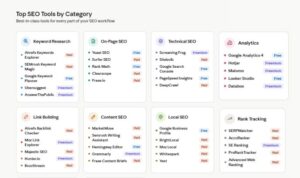
SEO tools play a vital role in improving website rankings, keyword research, technical optimization, and competitor analysis. The best SEO tools help businesses and bloggers increase organic traffic, enhance website performance, and achieve better visibility on Google search results.
For keyword research and competitor analysis, tools like Ahrefs, Semrush, and Ubersuggest are widely used by SEO professionals to discover high-ranking keywords and backlink opportunities.
Google Search Console and Google Analytics are essential for monitoring website performance, indexing issues, and user behavior. For technical SEO audits and website crawling, Screaming Frog and Sitebulb help identify broken links, crawl errors, and Core Web Vitals problems.
Content optimization tools such as Surfer SEO, Frase, and Clearscope assist in creating SEO-friendly articles optimized for search intent and rankings. Meanwhile, Moz and BuzzSumo are popular for link-building strategies, domain authority tracking, and content marketing research.
Choosing the right SEO tools by category allows website owners to build a complete SEO strategy that supports higher rankings, better user experience, improved search engine visibility, and long-term Google AdSense approval success.
FAQs:
How long does it take for an SEO strategy to show results?
Most new content takes 3–6 months to achieve stable rankings. Research shows only 5.7% of pages reach the top 10 within a year of publication. Technical changes can take effect in days; content and authority-building typically requires several months. Consistency is the deciding factor.
What is the difference between an SEO strategy and SEO tactics?
Your SEO strategy is the long-term plan — the what and why. SEO tactics are the specific actions — the how. Strategy defines your goals, priorities, and overall approach. Tactics are the individual steps you take to execute it, such as writing a specific article, earning a backlink from a target publication, or fixing a crawl error.
What Is SEO still worth investing in with the rise of AI search?
Absolutely. Optimizing well for Google also positions you strongly for ChatGPT and Perplexity, since strong traditional SEO signals (E-E-A-T, authoritative backlinks, structured content) are precisely what AI systems rely on when selecting sources to cite. SEO delivers $22 in return for every $1 invested on average making it one of the highest-ROI marketing channels available.
What is the most important SEO ranking factor in 2026?
There is no single silver bullet. Google confirms that the top ranking signals are relevant, high-quality content; authoritative backlinks from trusted sources; Core Web Vitals performance; and strong E-E-A-T signals. It is the combination working together that wins.
How often should I revisit and update my SEO strategy?
Review your strategy quarterly and conduct a comprehensive audit annually. Algorithm updates, evolving AI search behaviors, and shifting user intent all require regular adaptation. Build a rhythm of consistent action, measurement, and improvement not reactive responses to every news cycle.