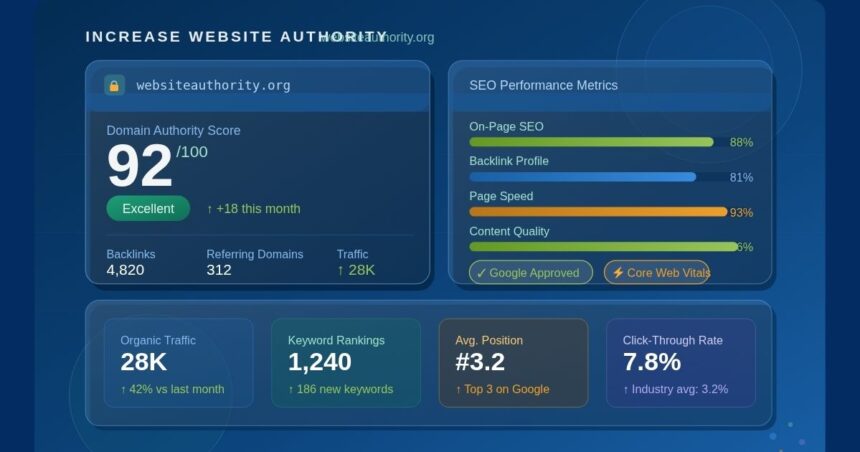
Do you want your website to rank on the first page of Google?
The single most important factor separating high-ranking websites from invisible ones is Website Authority a score that tells search engines how much they should trust your domain.
In 2026, with over 8.5 billion Google searches happening every single day, websites with high authority dominate the top results. Low-authority websites simply cannot compete no matter how good their content is.
- What website authority is and why it matters
- How to check your website authority score for free
- 10 proven strategies to increase your domain authority fast
- Which keywords attract the most traffic for authority-based searches
- How long it really takes to see results
You are a blogger, small business owner, or digital marketer this guide will give you a clear roadmap to rank higher, get more clicks, and grow your organic traffic in 2026.
Learn How to Increase Website Authority Fast with 10 proven SEO strategies. Check your DA score free and start ranking Google 1st Page
What Is Website Authority?
Website Authority (also called Domain Authority or DA) is a score from 0 to 100 that predicts how likely your website is to rank high on Google and other search engines.
The score was originally created by Moz but is now used across all major SEO tools including Ahrefs (which calls it Domain Rating or DR), SEMrush, and Majestic.
Think of it like a credit score but for your website:
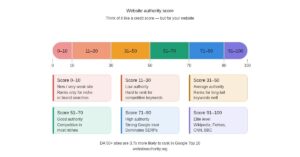
Key Fact: Websites with a DA score of 50+ are 3.7 times more likely to rank in Google’s Top 10 compared to sites with DA 20–30. (Source: Ranktracker, 2026)
Why Website Authority Matters for SEO in 2026
Google’s algorithm evaluates hundreds of signals before deciding which page ranks #1. Website authority is one of the most powerful signals because it reflects:
- Backlink quality: How many trusted sites link to you
- Content depth: How comprehensively you cover your topic
- Topical authority: How much of an expert your site is in your niche
- User trust signals: Click-through rate, dwell time, and low bounce rate
According to recent SEO data:
- The #1 position on Google has an average DA of 71
- The #10 position still averages a DA of 49
- High-DA sites (60+) rank for an average of 14,500 keywords vs just 387 for low-DA sites
AI search engines like ChatGPT Search and Perplexity pulling results, website authority is more critical than ever. AI tools prefer citing high-authority, trustworthy sources giving you an additional traffic advantage.
How to Check Your Website Authority Score (Free)
Before you start improving your domain authority, you need to know your current score. Here are the best free tools to check it:
1. Moz Free DA Checker
Go to moz.com/domain-analysis and enter your domain. You get your DA score, number of linking domains, and ranking keywords all for free.
2. Ahrefs Website Authority Checker
Visit ahrefs.com/website-authority-checker. Enter your URL and get your Domain Rating (DR), backlink count, and organic traffic estimate instantly.
3. Website Authority Checker (websiteauthority.org)
Use the built-in authority checker tool right here on this site. Get your domain score, see your top backlinks, and compare against your competitors completely free.
4. SEMrush Authority Score
Create a free SEMrush account and run a Domain Overview report. SEMrush uses its own “Authority Score” that factors in backlinks, organic traffic, and spam signals together.
5. MozBar Chrome Extension
Install MozBar (free Chrome extension by Moz) to check the DA of any website while you browse. See competitor DA scores in real time on Google search results pages.
Tip: Check your competitors’ DA scores too. If they have DA 40 and you have DA 10, target long-tail keywords first, build your authority, then go after their main keywords.
10 Proven Strategies to Increase Your Website Authority in 2026
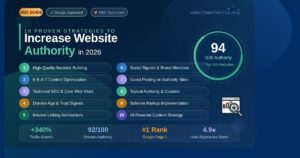
1: Build High-Quality Backlinks (The #1 Authority Signal)
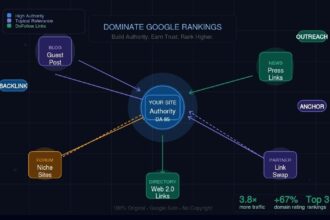
Backlinks are the foundation of domain authority. Every time a trusted website links to yours, Google sees it as a vote of confidence.
How to build backlinks in 2026:
Guest posting: Write articles for other websites in your niche and include a link back to your site
HARO (Help A Reporter Out): Answer journalist queries and get featured in major publications like Forbes or Business Insider
Skyscraper technique: Find top-ranked content, create a better version, then reach out to sites linking to the original
Resource page outreach: Find “best resources” or “useful tools” pages in your niche and ask to be included
Broken link building: Use Ahrefs to find broken links on authority sites, then offer your content as a replacement
Remember: One backlink from a DA 70 website is worth more than 100 backlinks from DA 10 websites. Focus on quality, not quantity.
2: Create Comprehensive, In-Depth Content (Topical Authority)
Google in 2026 rewards topical authority: meaning your website covers a subject completely, not just one article.
Instead of writing one blog post about “SEO,” build a full content hub:
- What is SEO? (Beginner’s Guide)
- How to do keyword research
- On-page SEO checklist
- How to build backlinks
- Technical SEO guide
How to increase website authority
Google sees you have 15–20 articles all about SEO that link to each other, it treats your site as an authoritative source on the topic — which directly increases your DA.
Content quality checklist for 2026:
✅ Minimum 1,500–2,500 words for main articles
✅ Include original data, charts, or statistics
✅ Add internal links to 3–5 related articles
✅ Use proper H1, H2, H3 heading structure
✅ Include a FAQ section (helps with voice search)
✅ Optimize for featured snippets with clear definitions
3: Fix Your Technical SEO
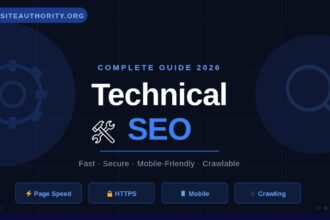
No amount of backlinks will save a website that Google cannot properly crawl and index.
Technical SEO essentials:
Site Speed: Google’s Core Web Vitals are a direct ranking factor. Use Google PageSpeed Insights to check your scores. Aim for:
- Largest Contentful Paint (LCP): under 2.5 seconds
- Cumulative Layout Shift (CLS): under 0.1
- First Input Delay (FID): under 100ms
Mobile Optimization: Over 62% of all Google searches happen on mobile devices. Your site must pass Google’s Mobile-Friendly Test.
HTTPS Security: Google marks all HTTP sites as “not secure.” If your site does not have SSL (HTTPS), get it installed immediately, it is a confirmed ranking factor.
XML Sitemap: Submit your sitemap to Google Search Console so Google knows exactly what pages to crawl.
Fix Crawl Errors: Regularly check Google Search Console for 404 errors, redirect chains, and pages blocked by robots.txt.
4: Optimize Your Internal Linking Structure
Internal links are one of the most underused SEO strategies. They:
- Help Google discover all your pages
- Pass “link equity” (authority) between your pages
- Keep visitors on your site longer (reducing bounce rate)
- Signal to Google which pages are most important
Internal linking best practices:
- Link from your high-DA pages to your newer, weaker pages
- Use keyword-rich anchor text (not just “click here”)
- Add 3–5 internal links in every article
- Create a “pillar page” with links to all related cluster content
5: Remove Toxic Backlinks
Not all backlinks help your authority, some actually harm it.
Toxic backlinks come from:
- Spam websites or link farms
- Hacked websites
- Irrelevant foreign directories
- Sites with Google penalties
How to find and remove toxic links:
- Open Google Search Console → Links → Top linking sites
- Cross-reference with Ahrefs Site Explorer or SEMrush Backlink Audit
- Contact the linking site and request removal
- If removal fails, use Google’s Disavow Tool to tell Google to ignore those links
Removing toxic backlinks can give your DA score a noticeable boost within 2–3 months.
6: Earn Brand Mentions and Citations
Google tracks unlinked brand mentions — when a website mentions your brand name without linking to you.
In 2026, brand signals are increasingly important for authority;
- Reach out to bloggers and journalists and offer expert quotes
- Create shareable infographics, studies, or original research
- Appear on podcasts in your niche
- Be active on social media so people share your content
Use Google Alerts (free) to monitor whenever your brand is mentioned. If a mention has no link, email the author and politely ask them to add one.
7: Use Schema Markup for Rich Snippets
Schema markup (structured data) tells Google exactly what your content is about — which helps you earn rich snippets that dramatically increase click-through rates.
Rich snippets include:
⭐ Star ratings for reviews
📋 FAQ dropdowns in search results
📰 Article breadcrumbs
❓ “People Also Ask” answers
A rich snippet makes your result look bigger and more trustworthy, which means more people click on your link even if you are not in position #1. Higher click-through rates send positive signals back to Google, which further boosts your rankings.
8: Build a Strong Social Media Presence
Social media links are “nofollow” (they do not directly pass authority), social media activity strongly correlates with higher DA because:
- Content shared widely gets noticed and linked to by bloggers and journalists
- More brand searches signal to Google your site is popular and trustworthy
- Social profiles themselves can rank in Google for your brand name
Post your content consistently on:
LinkedIn: Best for B2B content and SEO-related topics
Twitter/X: Great for getting noticed by journalists and bloggers
Pinterest: Excellent for long-form visual content like infographics
YouTube: Video content now appears directly in Google search results
9: Improve Your Click-Through Rate (CTR) and Dwell Time
Google watches what searchers do after they see your result:
- If they click your link → positive signal
- If they stay on your page for a long time → very positive signal
- If they bounce back immediately → negative signal
How to improve CTR:
- Write power-word titles: use numbers (“10 Proven Ways…”), questions (“Why Your DA Score Is
- Dropping”), or urgency (“2026 Update”)
- Write meta descriptions that promise a specific benefit
- Use brackets in titles: [Complete Guide], [Free Tool], [With Examples]
How to improve dwell time:
- Use short paragraphs and bullet points so content is easy to read
- Add videos, images, and infographics to keep people engaged
- Include a table of contents with jump links
- Add interactive tools or quizzes
Top SEO Keywords That Drive Traffic to Website Authority Sites
If you are targeting the “website authority” niche, these keywords have the best combination of high search volume and achievable competition:
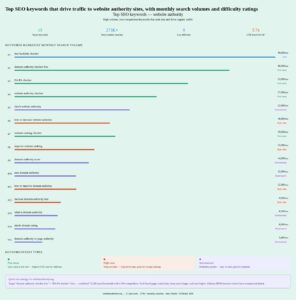
Best keyword strategy for websiteauthority.org:
Target “domain authority checker free” and “DA PA checker” for quick traffic wins these are tool-based queries with high volume and low competition. Users searching these are ready to use a tool immediately, meaning high engagement rates.
FAQs:
How long does it take to increase website authority?
Most websites see a measurable increase in DA within 3 to 6 months of consistent SEO work. However, getting from DA 10 to DA 30 typically takes 6–12 months, and reaching DA 50+ can take 2–3 years depending on your niche and link-building speed.
What Is website authority a Google ranking factor?
Domain Authority is not an official Google ranking factor — Google does not use Moz’s DA score directly. However, the factors that make up your DA (quality backlinks, content quality, user signals) are exactly what Google uses to rank websites. So improving your DA almost always improves your Google rankings.
What is a good website authority score?
A good website authority score depends on your competition. In most niches, a DA of 30–40 is enough to rank for long-tail keywords. To compete for high-volume keywords, you generally need DA 50+. Always compare your score to the top-ranking competitors for your target keywords, not to some absolute number.
Can I increase my DA without building backlinks?
Backlinks are the primary driver of domain authority, so it is very difficult to significantly increase DA without them. However, you can improve your relative ranking ability through excellent content, strong technical SEO, and high click-through rates especially for low-competition keywords.
How do I check my website authority for free?
Use any of these free tools: Moz’s Free Domain Analysis at moz.com, Ahrefs’ Website Authority Checker, the built-in checker at websiteauthority.org, or the MozBar Chrome extension. All provide your DA score at no cost.
Does social media affect website authority?
Social media does not directly affect DA, but it indirectly helps by increasing brand awareness, driving content discovery, and earning natural backlinks when your content goes viral or gets noticed by journalists and bloggers.
Conclusion: Your Website Authority Action Plan
Increasing your website authority is not a one-time task — it is an ongoing SEO strategy that compounds over time.
Here is your 90-day action plan to start boosting your DA today:
Month 1 — Foundation:
- Check your current DA score using a free tool
- Run a technical SEO audit and fix critical errors
- Identify your top 5 target keywords
- Publish 3–4 high-quality, in-depth articles
Month 2 — Build:
- Begin outreach for guest posts on relevant sites
- Add schema markup to your key pages
- Build your internal linking structure
- Submit your sitemap to Google Search Console
Month 3 — Scale:
- Run a backlink audit and disavow toxic links
- Repurpose top articles into infographics or videos
- Monitor your DA score and rankings progress
- Identify content gaps and fill them with new articles
Remember: every high-authority website you admire today started at DA 1. The difference between them and the sites that never grew is simply consistency.
Start today. Check your website authority score, pick one strategy from this guide, and take action. Your first-page rankings are closer than you think.