Website authority measures your domain’s SEO strength and ranking potential. Learn how to check, understand, and improve your website authority score for better search results.
Website Authority is an SEO concept that describes the overall “strength” or “trustworthiness” of a domain in the eyes of search engines. In simple terms, it reflects how likely a given website is to rank well in search engine results pages (SERPs) and how much SEO value it can pass on to other sites through backlinks.
Think of website authority as a reputation score. Just like a reputable expert’s opinion carries more weight than that of a newcomer, a high-authority website carries more weight in Google’s eyes than a new or low-quality site.
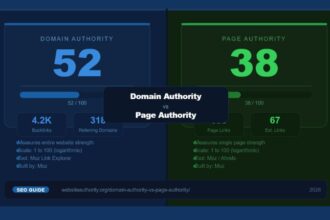
It is important to understand that website authority as a concept is not the same as the specific metrics offered by various SEO tools. Several tools have developed their own proprietary scoring systems to help SEOs measure and compare domain strength:
- Domain Authority (DA) — developed by Moz, measured on a scale of 1 to 100
- Domain Rating (DR) — a similar metric used Ahrefs to estimate a site’s backlink-based strength compared to others on the web, also measured from 0 to 100
- URL Rating (UR) — focuses on the strength of an individual page rather than the whole domain
Each of these tools uses its own algorithm. They are useful for comparison and benchmarking — but they are not official Google metrics.
Why Does Website Authority Matter for SEO?
Google has publicly stated that it does not use third-party authority metrics like DA or DR as direct ranking factors. However, Google’s own representatives have confirmed that an internal sitewide signal exists – one that functions similarly to these external scores.
So why should you care about website authority?
Because the factors that drive website authority — such as backlink quality, content relevance, and technical health – are the same factors that drive Google rankings. Building website authority and building Google ranking ability are two sides of the same coin.
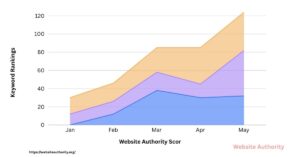
Here is what research into website authority and keyword rankings has consistently shown:
- There is a strong positive correlation between a website’s domain-level authority score and its ability to rank for competitive keywords
- Websites with stronger backlink profiles consistently outperform weaker ones in organic search
- High-authority domains tend to earn more organic traffic over time — creating a compounding effect
In short: even if Google doesn’t plug your “website authority score” directly into its algorithm, the underlying signals it represents absolutely matter.
How Is Website Authority Calculated?
Different tools calculate website authority differently, but most rely heavily on a website’s backlink profile, specifically:
1. Number of Referring Domains
The more unique domains link to your website, the more authority signals you receive. A hundred links from one website count far less than links from a hundred different domains.
2. Authority of Referring Domains
Not all backlinks are equal. A single link from a highly trusted, well-established website is worth far more than dozens of links from low-quality or spammy sites.
3. Link Distribution
If a referring website links out to thousands of other sites, it passes less authority to each one. Fewer outbound links from a referring domain means more value is passed to yours.
4. Content Relevance
Links from websites that are topically relevant to your own content tend to carry more SEO weight than links from completely unrelated sites.
5. Technical Factors
Site speed, mobile-friendliness, crawlability, and clean site architecture all influence how search engines perceive and trust your website, indirectly contributing to its authority.
What Is a Good Website Authority Score?
There is no single “good” website authority score that applies universally. The right benchmark depends on your industry, competition level, and goals.
The key insight: Your website authority score only matters in context. A score of 35 may be perfectly competitive in a low-competition niche, while even a score of 60 may not be enough in a highly competitive industry like finance or health.
Always compare your score against your direct competitors, not against global benchmarks.
How to Check Your Website Authority
To check your current website authority, you can use a website authority checker — a free or paid SEO tool that analyzes your domain’s backlink profile and assigns a score.
Many SEO platforms offer this feature. Simply enter your domain URL, and the tool will show your current authority score, number of referring domains, and other relevant backlink data.
For the most accurate picture, check your authority score regularly and track it over time. A single snapshot means little, what matters is the trend.
How to Increase Website Authority: 7 Proven Strategies
Building website authority is a long-term strategy. Do not expect overnight results. However, by consistently applying the following tactics, you will see steady, compounding growth.
1. Earn High-Quality Backlinks
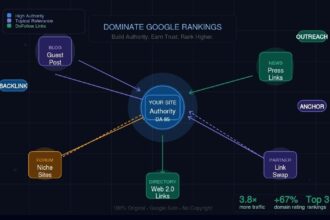
The most impactful thing you can do for your website authority is build a strong backlink profile. Focus on earning links from:
- Reputable websites in your niche
- News publications and industry blogs
- Resource pages and directories relevant to your topic
- Partner websites and suppliers
Quality always trumps quantity. One backlink from a trusted, relevant source is worth far more than fifty links from low-quality sites.
2. Create Link-Worthy Content
The best way to attract backlinks naturally is to create content that people genuinely want to share and reference. This includes:
- Original research and data – unique studies or surveys that others cite
- Comprehensive guides – in-depth resources that answer a topic completely
- Infographics and visuals – shareable assets that summarize complex information
- Free tools and templates – practical resources that solve real problems
3. Focus on Topical Relevance
Website authority is not just about how many sites link to you — it is about who links to you. Links from websites that are closely related to your topic signal relevance and authority to search engines.
Build your site’s topical depth by covering related subjects thoroughly. The more comprehensively you cover a topic, the more likely you are to be seen as an authority, both by Google and by other websites that may link to you.
4. Fix Technical SEO Issues
A technically sound website builds trust and earns authority more efficiently. Audit your site regularly for:
- Broken links and redirect chains
- Slow page load times
- Poor mobile experience
- Missing or duplicate meta tags
- Crawl errors and indexing problems
Google rewards websites that offer a smooth, fast, and accessible user experience.
5. Build Internal Links Strategically
Internal linking helps distribute authority across your website. When you link from a high-authority page on your site to a newer or lower-authority page, you pass some of that link equity internally.
Create a clear internal linking structure that connects related content and guides visitors (and search engines) through your most important pages.
6. Remove or Disavow Toxic Backlinks
Not all backlinks help your authority — some can actively hurt it. Links from spammy, irrelevant, or low-quality sites can drag down your domain’s reputation.
Periodically audit your backlink profile and:
- Reach out to webmasters to remove harmful links
- Use Google’s Disavow Tool as a last resort for links you cannot remove manually
7. Be Patient and Consistent
Website authority builds over time. Consistency matters more than bursts of activity. Publish content regularly, continue building relationships for backlinks, and maintain your technical SEO standards.
Sites that have been around longer and consistently publish quality content tend to accumulate authority naturally, and that momentum only grows.
Common Mistakes to Avoid When Building Website Authority
Buying Links or Using Link Farms
Artificially inflating your backlink profile through purchased links or private blog networks (PBNs) is a violation of Google’s guidelines. When discovered, and Google is getting better at detecting this’ it results in penalties that can devastate your rankings.
Focusing Only on the Score, Not the Strategy
Website authority scores are a useful indicator, but they are not the goal. A high DA or DR score means nothing if your content is poor or your traffic is low. Use the score as a benchmark, not as an end in itself.
Ignoring Low-Authority Referring Sites
Do not automatically dismiss backlinks from websites with lower authority scores. If a site is highly relevant to your niche and attracts genuine organic traffic, a link from it can still be very valuable. Relevance often matters more than raw authority score.
Neglecting On-Page SEO
Backlinks alone will not make you rank. Google evaluates the quality and relevance of your content alongside its authority signals. Strong on-page SEO – well-structured, keyword-relevant, user-friendly content, is just as important as building external links.
Final Thoughts
Website authority is one of the most important concepts in SEO’ and one of the most misunderstood. It is not a single metric, and no tool perfectly captures it. But the underlying principle is clear: websites that earn trust, attract quality links, and deliver valuable content accumulate authority over time and that authority translates directly into better rankings, more traffic, and greater online visibility.
The most effective approach is simple: stop chasing a number, and start building a website that genuinely deserves to rank.
FAQs:
Does Google use website authority as a ranking factor?
Google does not officially use third-party metrics like DA or DR. However, the underlying signals these metrics reflect particularly backlink quality and quantity are confirmed ranking signals. Google’s PageRank algorithm, which evaluates links, remains a core part of how it ranks websites.
How long does it take to build website authority?
There is no fixed timeline. New websites typically take 6–12 months to begin building meaningful authority. Significant authority enough to compete in moderately competitive niches can take 1–3 years of consistent effort.
Can I lose website authority?
Yes. Website authority can decline if you lose backlinks, receive a Google penalty, or your competitors build authority faster than you. Regular audits and ongoing link-building efforts help maintain and grow your authority over time.