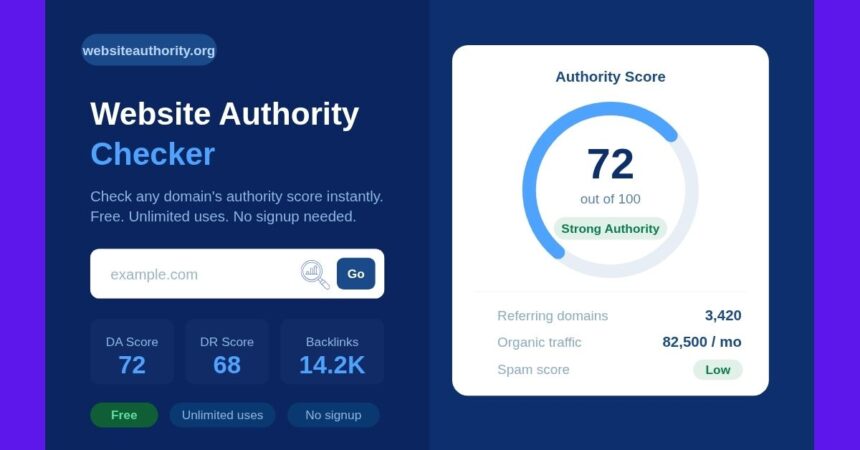
A Website Authority Checker is a free SEO tool that gives your domain a score from 0 to 100, reflecting how strong your site is in search engines. The higher your score, the more likely your pages are to rank on Google.
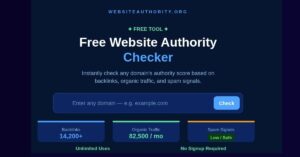
Free Website Authority Checker instantly check any domain’s authority score based on backlinks, organic traffic, and spam signals. Unlimited uses, no signup required.
1. What Is a Website Authority Checker?
Website Authority Checker is an SEO tool that measures the overall strength and trustworthiness of a domain. It gives you a numeric score typically on a scale from 1 to 100, that estimates how likely that website is to rank well in Google search results for competitive keywords.
Think of it like a credit score for your website. Just as a higher credit score opens more financial doors, a higher website authority score signals to search engines that your site is credible, reliable, and worth showing at the top of search results.
Major brands like Forbes, HubSpot, or Wikipedia have very high authority scores, which is why they can rank for almost any keyword, even highly competitive ones. A new website, on the other hand, starts with a low score and must build authority gradually over time.
It is important to note that Google does not officially publish any “authority score.” Tools like Moz, Ahrefs, and Semrush have created their own proprietary metrics to estimate this strength. These are third-party indicators, not official Google measurements — but they are widely used by SEO professionals worldwide.
2. How Does Website Authority Work?
Website authority is calculated using several key signals that SEO tools analyze from publicly available data. The three most important factors are:
🔗 Backlink Quality & Quantity
Backlinks — links from other websites pointing to yours — are the single biggest factor in website authority. But not all backlinks are equal. A single link from a high-authority site like BBC.com or Harvard.edu is worth far more than hundreds of links from low-quality or spammy sites. Tools look at how many unique domains link to you and how strong those domains are.
📈 Organic Traffic
Some tools, like Semrush, also factor in the amount of organic traffic your site receives from search engines. A site that ranks for thousands of keywords and gets real visitors is considered more authoritative than one that has backlinks but no actual traffic.
🚫 Spam Signals
Tools also scan for suspicious link patterns such as thousands of links from the same IP address, an unnaturally high percentage of dofollow links, or links from irrelevant or penalized sites. These spam signals can lower your authority score even if you have many backlinks.
The combination of these signals produces a final authority score that gives you a reliable snapshot of how your domain compares to others in your industry.
3. DA vs DR vs Authority Score Key Differences
When you use different website authority checker tools, you will notice they use different names and scoring methods. Here is a clear breakdown of the three most popular metrics:
SEO, many beginners get confused between DA, DR, and Authority Score. All three are website authority metrics, but each tool measures them differently. Search Engine Optimization
DA (Domain Authority) is created by Moz and predicts how well a website can rank on search engines. It uses backlinks, domain quality, and other SEO factors to calculate a score from 1 to 100.
DR (Domain Rating) is developed by Ahrefs and mainly focuses on the strength of a website’s backlink profile. A higher DR usually means stronger backlinks from quality websites.
Authority Score is provided by Semrush. It combines backlinks, organic traffic, and spam factors to show the overall quality and trust of a domain.
The main difference is that DA predicts ranking ability, DR measures backlink strength, and Authority Score checks overall website trust and SEO performance. These metrics are useful for comparing websites, planning link-building strategies, and improving search rankings naturally.
Each tool uses its own formula, so your score will differ across platforms. This is completely normal. Instead of comparing scores across tools, use one tool consistently to track your progress over time. Focus on improvement trends, not absolute numbers.
Pro Tip: All authority metrics use a logarithmic scale. This means going from a score of 20 to 30 is much easier than going from 60 to 70. Expect progress to slow down as your score climbs higher.
4. Best Free Tools to Check Website Authority
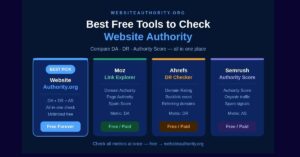
Checking website authority is important for improving SEO performance and building a strong online presence. Search Engine Optimization Many SEO professionals use trusted tools to analyze metrics like Domain Authority (DA), Domain Rating (DR), and Authority Score (AS). These metrics help website owners understand backlink quality, domain strength, and ranking potential in search engines.
WebsiteAuthority.org is a free all-in-one tool that allows users to quickly check DA, DR, and Authority Score in one place. It is useful for beginners who want fast website authority analysis without creating an account.
Moz Link Explorer is one of the most trusted SEO tools developed by Moz. It is widely known for providing accurate Domain Authority (DA) scores and detailed backlink analysis for websites.
Ahrefs DR Checker by Ahrefs helps users check Domain Rating (DR) for free. It mainly focuses on backlink strength and is useful for evaluating link-building opportunities.
Semrush Authority Checker from Semrush provides Authority Score (AS) by combining backlink data, organic traffic, and spam analysis. This tool is ideal for measuring overall website trust and SEO performance.
Using these SEO authority checker tools can help website owners compare competitors, improve backlinks, and increase search engine visibility over time.
5. What Is a Good Website Authority Score?
A good website authority score depends on your industry, competition, and website age, but in general, a higher score shows better trust and stronger SEO performance. Search Engine Optimization New websites usually start with a low authority score, while established websites with quality backlinks and consistent traffic often achieve much higher scores.
For most websites, an authority score between 20 and 40 is considered decent for growing online visibility. Scores between 40 and 60 indicate a strong and trusted website, while scores above 60 are usually achieved by highly popular brands and authoritative domains. These scores are influenced by backlink quality, organic traffic, content relevance, and overall domain trust.
SEO tools from Moz, Ahrefs, and Semrush use different methods to calculate authority metrics, so scores may vary between platforms. Instead of focusing only on numbers, website owners should aim to create high-quality content, earn natural backlinks, improve user experience, and maintain consistent SEO practices.
Improving website authority takes time, but with strong content, proper optimization, and trusted backlinks, a website can gradually increase its authority score and achieve better rankings in search engine results.
6. How to Check Your Website Authority (Step-by-Step)
Checking your website authority takes less than 60 seconds. Here is exactly how to do it:
Go to a Website Authority Checker Tool
Visit websiteauthority.org or any of the free tools listed above. No account is required for most basic checks.
Enter Your Domain Name
Type your full domain (e.g., yourwebsite.com) into the search box. You can check your own site or any competitor’s domain.
Review Your Authority Score & Key Metrics
The tool will show your authority score, number of backlinks, referring domains, and organic traffic estimate. Note all of these numbers.
Check Your Competitors
Enter 2–3 competitor domains to see how your score compares. This tells you how much work is needed to outrank them.
Track Changes Monthly
Authority scores change slowly. Check your score every 30 days to monitor progress. A rising score means your SEO efforts are working.
7. How to Improve Your Website Authority

Growing your website authority is a long-term process, but the strategies below are proven to work. Implement them consistently and you will see steady improvement over months.
🔗 Build High-Quality Backlinks
Backlinks are the most powerful factor in improving authority. Focus on earning links from reputable, relevant websites in your industry. Effective methods include:
Guest posting: Write valuable articles for established blogs in your niche. Include a link back to your site in the author bio or content.
Digital PR : Get your brand mentioned in online news articles, industry publications, and authoritative websites.
Broken link building: Find broken links on other websites and suggest your content as a replacement.
Create linkable assets: Produce original research, free tools, infographics, or ultimate guides that others naturally want to link to.
Resource page link building : Ask websites with “resource” or “recommended tools” pages to include your site.
📝 Publish High-Quality, Helpful Content
Content remains the foundation of every authority-building strategy. Publish comprehensive, well-researched articles that genuinely help your target audience. Content that answers real questions, solves real problems, and provides unique insights earns organic backlinks naturally — without you having to ask.
Focus on E-E-A-T (Experience, Expertise, Authoritativeness, and Trustworthiness) — Google’s own framework for evaluating content quality. Show credentials, cite sources, and demonstrate real-world expertise.
🛠️ Fix Technical SEO Issues
A technically sound website signals credibility to both users and search engines. Key technical improvements include switching to HTTPS (SSL certificate), improving page load speed, making your site mobile-friendly, fixing broken links and 404 errors, and submitting an XML sitemap to Google Search Console.
🚫 Avoid Spammy Links
Low-quality backlinks from link farms, private blog networks (PBNs), or unrelated websites can hurt your authority score and risk a Google penalty. Regularly audit your backlink profile using tools like Ahrefs or Google Search Console, and disavow any harmful links you discover.
📣 Promote Your Content
Great content that nobody sees earns no links. Actively promote every article you publish through social media, email newsletters, community forums, and direct outreach to people mentioned in your content. More visibility leads to more natural backlinks and, over time, higher authority.
Important: Website authority grows slowly. Most sites see meaningful score increases after 3–6 months of consistent SEO work. Do not expect overnight results — focus on building genuine value, and the numbers will follow.
Check Your Website Authority Right Now Free
Get your domain authority score, backlink count, and full SEO health report in seconds.
Conclusion:
Website Authority Checker is one of the most useful free tools in any SEO toolkit. It gives you a clear, at-a-glance measure of how competitive your domain is and helps you understand exactly where to focus your efforts.
Remember: authority is not built overnight. It is the result of consistently publishing great content, earning quality backlinks, and maintaining a technically healthy website. Every improvement you make today compounds over time into lasting Google rankings and organic traffic growth.
Start by checking your score at WebsiteAuthority.org, benchmark yourself against your competitors, and put a plan in place to close the gap. Your higher ranking is waiting for you.
FAQs:
What is a Website Authority Checker?
Website Authority Checker is a free SEO tool that measures how strong and trustworthy a domain is for search engines. It gives a score from 0–100 based on the quality and quantity of backlinks, organic traffic, and other signals to estimate how likely your site is to rank well on Google.
What Is Domain Authority the same as Google PageRank?
No. Domain Authority (DA) is a metric created by Moz a private SEO company. Google has its own internal ranking system called PageRank, which is not publicly shown to website owners. DA and other authority metrics are third-party estimates designed to approximate SEO strength, but they are not official Google measurements.
What is a good website authority score?
There is no single “good” score it depends on your niche. Generally: 1–10 is new/beginner, 11–30 is developing, 31–50 is good, 51–70 is strong, and 71–100 is excellent. The best strategy is to compare your score to your direct competitors and aim to match or exceed theirs.
How often does website authority update?
Different tools update at different intervals. Moz typically updates Domain Authority scores every few weeks. Ahrefs and Semrush update more frequently. Because authority changes slowly, checking your score monthly is usually sufficient to track meaningful progress.
Can I increase website authority quickly?
There are no reliable shortcuts. Website authority grows gradually as you earn high-quality backlinks and publish helpful content. Most sites see noticeable improvement after 3–6 months of consistent SEO work. Avoid link schemes or buying backlinks — these can trigger Google penalties and lower your authority.
Does website authority affect my Google rankings?
Indirectly, yes. Google does not use DA, DR, or AS as direct ranking factors. However, the things that raise your authority score quality backlinks, helpful content, technical SEO health — are exactly the things Google’s algorithm rewards with higher rankings.
WebsiteAuthority.org Team
We help website owners understand and improve their SEO authority. Our free tools and guides are trusted by thousands of SEO professionals and business owners worldwide. Visit us at websiteauthority.org.
Enter a domain to check its authority score and reveal its SEO strength.